Old law books are the like the ginger children of the book world: they exist, but nobody likes to acknowledge the fact. Along with other factual texts for areas like science and medicine, an old law book is immediately discarded with joyful glee by users as soon as a new edition appears in the library, because relying on old law books is a dangerous thing – you don’t want to be the lawyer caught out because new case law or legislation that contradicts the point you want to make has been created since the edition you’re using. Often, the preceding edition of a text will be retained for reference if a substantial amount of the contents remain unchanged (with big warning stickers on the covers stating that it’s not current, please check the current version for more recent information), but any books older than that preceding edition are usually despatched to the Great Big Recycling Box.
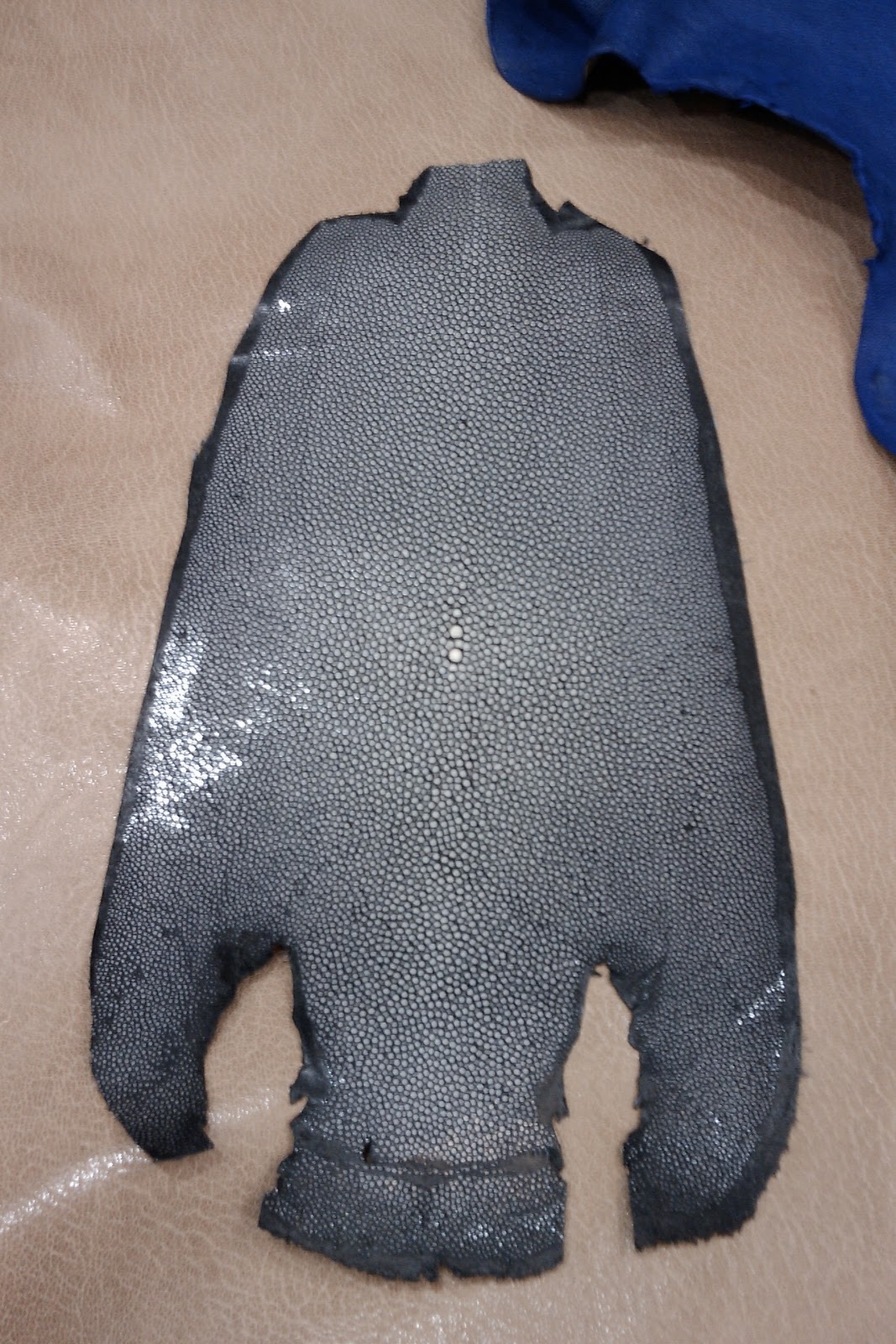 |
| Stingray skin, one option for making an interesting book cover! |
However, certain texts are likely to remain in a law library for longer than the law librarians staffing it might live: these texts are usually the writings of legal experts from the 1800 onwards, who have outlined core legal principles so clearly and precisely that they are still being referred to today, and frequently. Also, old cases which also clearly state various principles and ways to interpret the law and which are still adhered to today can see regular use. Due to their regular movements from shelf, to desk, to court, and back again, these old books suffer a lot of wear and tear, and are most likely to need occasional attention from a book repairer, in order to keep them useable for many more years. These expert services can be costly though, so when the opportunity to attend a hands-on book repair event came up, I thought it would be a good idea to attend, and see if I could pick up some tips on how to do some of the more basic repairs myself.
The demonstrators in attendance were providing the chance to watch or attempt to use a variety of the traditional skills and materials involved in bookbinding and book repair. I learned how the gold lettering and decoration is embedded into leather or bursam book bindings (HOT!); saw the types of materials that can be used to create the bindings (including a variety of shades of stingray skin, photo of the black one above); observed a text being bound by hand with thread in a loom-like frame; saw how book edges have different types of colours and marbling applied to them; and I was shown how to repair ripped or defaced pages.
Out of all the activities demonstrated, the page repairs are likely to be the most useful skill for me. Old book pages can be fragile, and a rip that starts off small can soon become much larger, escecially when a book and its pages are being flipped back and forth on a photocopier! Being able to make a small repair before it turns into something that needs professional attention could be time and money saving in the long run. So perhaps I should be investing in some of those meltable strips, and a travel iron to keep in a desk drawer, for OAP book first aid. I’m drawing the line though at getting a wee fabric baggie filled with tiny granules of rubber powder, that’s used to gently remove pencil marks and small blemished from pages….my books are just going to have to cope with me using my trusty National Library of Scotland eraser!


 Dumpling in a Hanky