JLSS Survey

I went to look at the news on the JLSS site, and decided I’d agree to take part in the survey – I thought I might be able to give some feedback about the removal of the Library / research area, and why it should be redesigned. After all, it did say “We would greatly appreciate it if you could complete a short survey to help us improve the Journal website. Click here to have your say”…

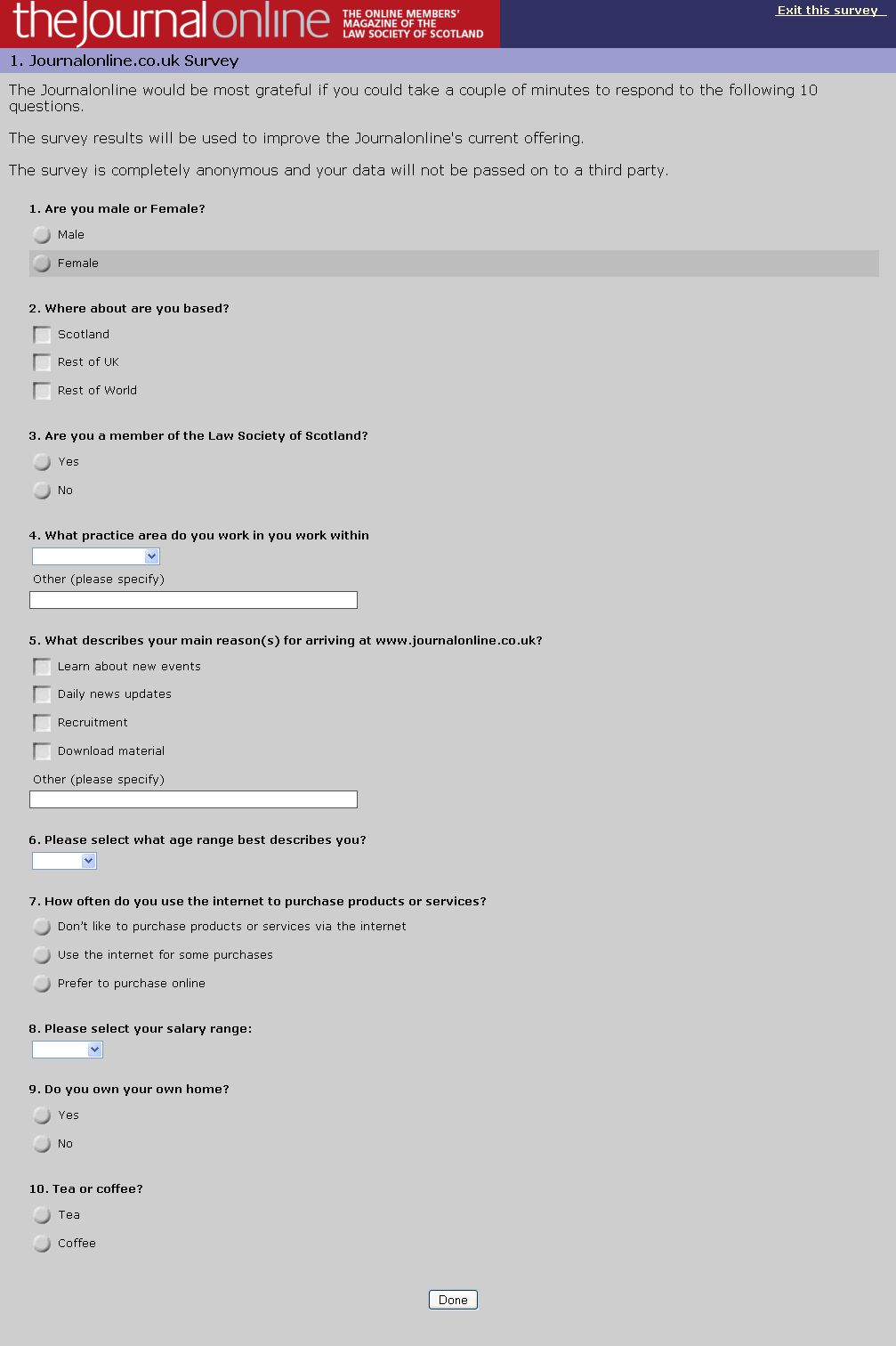
Instead, I got presented with the most random of surveys:

Erm…hello?
Exactly what has my home ownership status, and my hot beverage choice got to do with the website redesign, and the missing Library usefulness?!?

Is someone there taking the pee? Were they scrambling to find a way to fill up SurveyMonkeys default setting of 10 questions, and threw in the tea/coffee option?

Come on JLSS, you did an otherwise great redesign of the website (we’re ignoring the Library ‘thing’ for just now), can you please not let it all down at the end with a silly, unfocussed survey?!

The Free Legal Web – who for?

The current Big Idea in the legal / library blog world is the Free Legal Web (FLW). Originally mooted by Nick Holmes, the idea is to pull all of the content currently floating about the ether (legal professionals blog posts, Government information etc) into one portal. That in itself is a big enough task, but what doesn’t seem to be clear yet is…who is this Free Legal Web for?

The people involved so far seem to be legal professionals and IT specialists. The legal professionals will be working out some way of getting the useful materials together, and persuading other legal professionals that giving up their valuable time and work (such as blog postings) for this enterprise will be a worthwhile investment, and will reap them rewards in the end. The IT professionals job will be to write the scripts and programmes that will get everything together in the one place, and working well with all the other bits and pieces.

That’s all lovely (although it’s hard to tell what’s actually being done, as the discussions are going on behind an invite-only Google Group, which to me, kind of defeats the purpose of harnessing the collective intelligence of the legal and information professionals), but when this all singing, all dancing portal is up and running, who’s going to be using it? I would have thought this was a core question, to be settled right at the start, yet it doesn’t seem to have been discussed at any point.

If you’re designing a portal to work alongside the subscription legal databases like Westlaw and LexisNexis, then I assume it’s being aimed at people already working in the law, and therefore able to understand and interpret the information being presented to them there. The content will be academic / in depth, and of relevance to other members of the legal profession. Certain assumptions can be made about the level of knowledge and understanding of the user, and their grasp of the content. It also means it’s unlikely to be being used by members of the general public. Since legal professionals are likely to be persuaded into contributing to the FLW by the prospect of it eventually increasing their business through building of a reputation, this is not a good start.

If it’s designed for the general public, to allow them access to the elusive laws they’re meant to keep within, then good interpretation of the law is needed, not just access. People working in the law can forget just how difficult it is to find out what legislation means for people without access to subscription databases, information professionals to check for currency and further discussions of legal points…and even the language of legislation, while precise and succinct, can be incredibly confusing for someone with no experience of reading it, confronted with it for the first time. Content for this FLW would need a different focus – explaining the law and its impact on the general public, with references to the original case law rather than references to law reports inaccessible to the general public. Guides equivalent to first year law students introductions to the various aspects of the law would be needed. Clear signalling of whether legislation applies to all of the UK, or only the devolved areas would be essential. In other words, it would be a very different beast then the FLW designed for legal professionals.

So…is it a Professional Free Legal Web, or a Public Free Legal Web?

New JLSS website

You turn your back for 5 minutes…

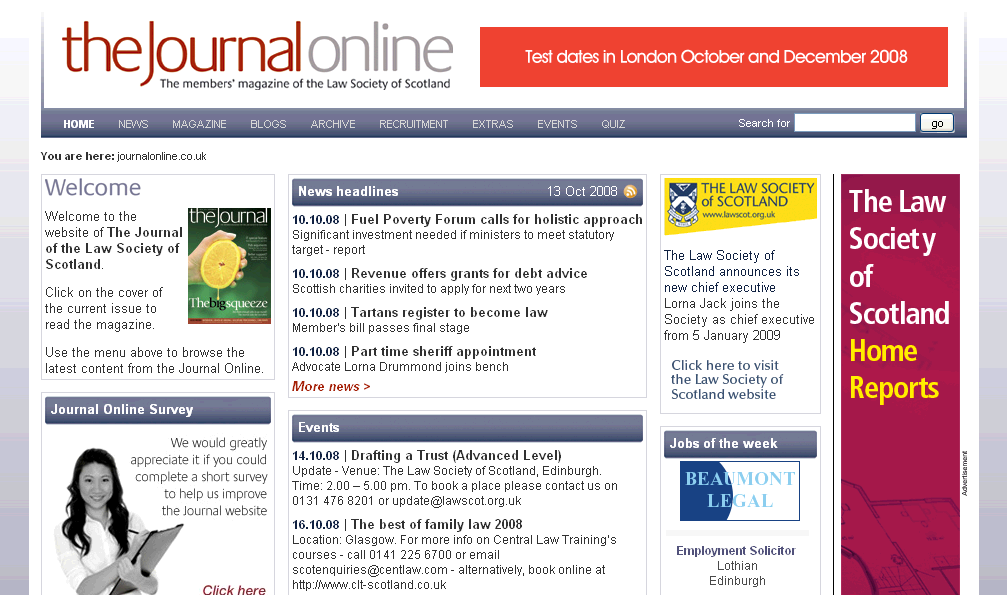
Last week, the Law Society of Scotland launched a redesigned website for the Journal of the Law Society of Scotland, with minimal (if any) fanfare. Well, there may well have been a fanfare, but as I’m not a solicitor and so therefore not on their emailing list, I only found out when I went to check up on their news area last week. It doesn’t even list it as something of note in their own News area…no press releases to The Firm Magazine, nor Scottish Legal News…is this some sort of terrible secret, not to be publicised to the world at large?

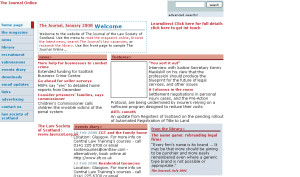
This is how it used to look (Feb 2008 image from Internet Archive):
This is how it looks now:

It is, however, a bit of a good news / bad news situation.

So we’ll start cheerfully with The Good News:

It’s pretty, it’s shiny, and looks much more sleek and modern.

The JLSS now has blogs, yay! There are links from the homepage to both the Editor’s blog, and the Law Society’s blog too.

http://www.journalonline.co.uk/Blogs/

The Editor’s blog launched on the 3rd October, which makes me think that that is possibly when the website was relaunched. Although there’s no mention of the shiny new website in any of the three posts so far.

There’s now an RSS feed for the News section, which means I won’t have to remember to go in every few days to check to see I’ve not missed anything.

Also good – lots more content from each issue of JLSS is now available on the site.

Now…The Bad.

The Archive (used to be Library) area of the site is the part I use most, and therefore also the part where I see the changes most.

The current issue of the JLSS showing is the August issue. Previously, it would show the current issue, which in this case would be the September issue. The appearance of the newest issue at the top of the site gave us an idea whether our copy had gone missing or not. And as the solicitors always seem to get their copies before the Library subs turned up, we were able to refer to the current issue pdf when we got the familiar requests saying “X told me Y would be in the Journal this month, is it?”. Now, we can’t do that.

Wait…as I wrote this I double checked the site again – it’s now the September issue showing. So, in the new way of working, does that mean the ‘new’ old issue appearing means the ‘new’new issue is due out, ie October? Follow that convoluted sentence if ya can!

The search option is just plain stupid. Again, a before and after comparison.

December 2007:
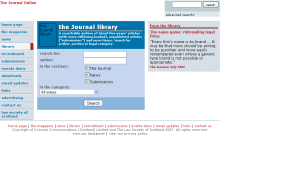
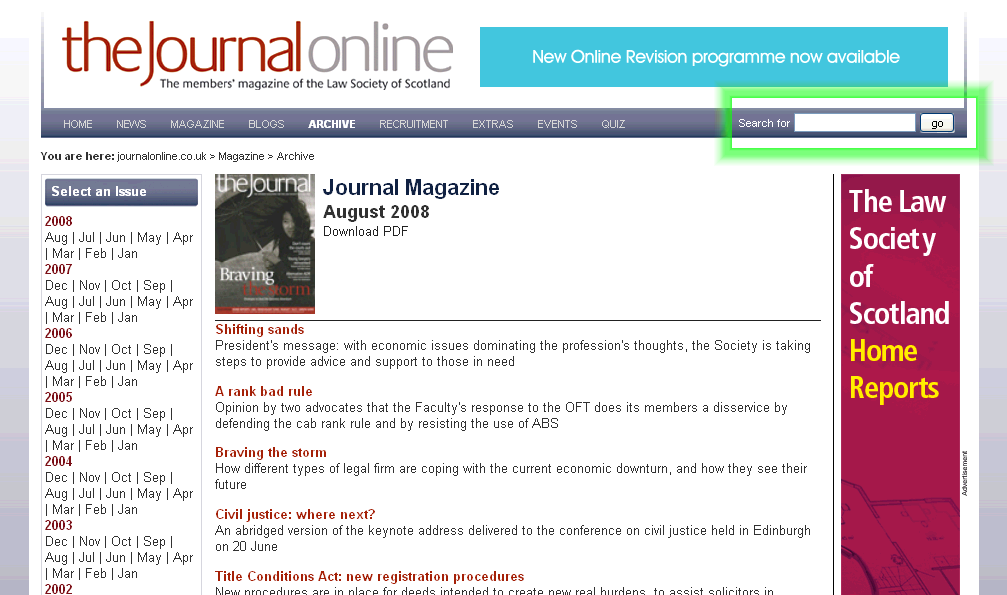
And now:

See that glowing box in the top right? Yup, that’s what used to be that lovely, restrictable search option, with 40+ categories to narrow it down by, the option to restrict it only to Journal material…

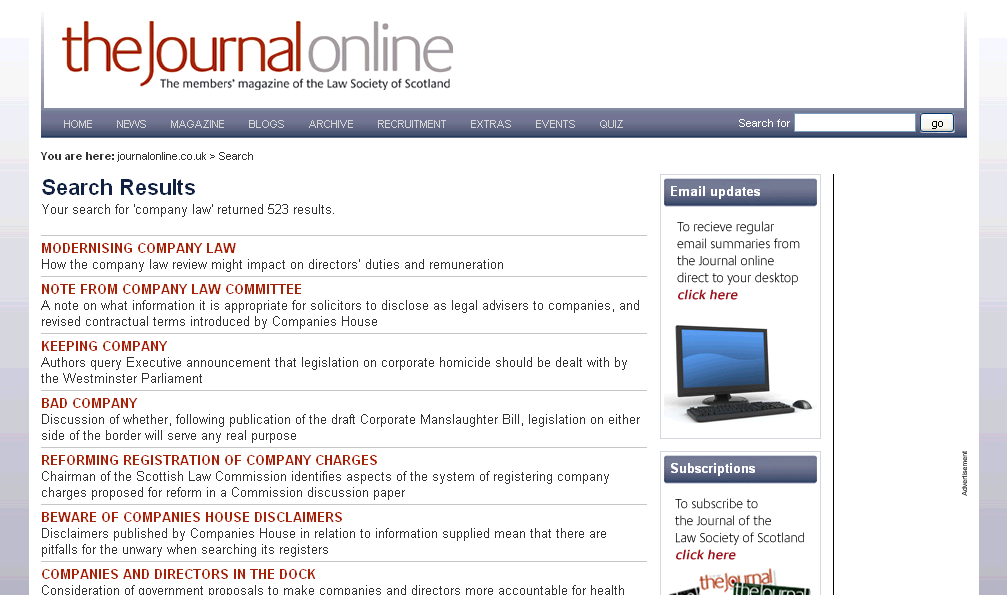
Now, you search all content, whether you like it or not. Thankfully, so far the magical “quotation marks” are helping, as you can see from my “company law” versus company law search results below:
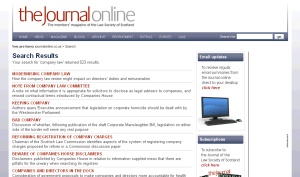
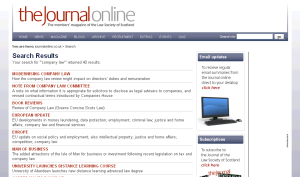
Also, it’s not helpful to not show the source of the results (news item, JLSS article?) in the returned hits. It means I have to click in to everything see if it’s just a newsy snippet, or a ‘proper’ result from the Journal. And what’s the ranking of the result? By relevance? Date? I have no idea, it doesn’t say.

In other words, they removed a good, accurate search tool, and replaced it with…well…meh.

So, JLSS, whoever you got to design your new website, could you ask them to put back the useful parts of it, while leaving the shiny new look? Kthxbai.
The elusive Scots law basics course?

I think that (thanks to the Scottish Legal Newsletter) I may have found the training course I’ve been looking for!

An introduction to law in contemporary Scotland” from the Open University looks like it’ll cover the basics well enough…it might not go into the further depth I’d like, but it’s a pretty good start!

This course looks at law making in contemporary Scotland and introduces you to some specific areas of Scots law including the law relating to employment and to children. It considers the role of both the Scottish Parliament and Courts in law making. The course will be of particular interest to anyone who wants an overview of how the legal system in Scotland operates and will provide an excellent beginning to students who want to understand how modern Scotland works.