Thing 16 – Advocacy (apparently, not advocaat, nor for drinking)

You may well have seen my grumpy-day post earlier on advocacy and activism, so Thing 16 is going to be a meandering thing around some of those points.

I still don’t feel comfortable with telling people how fabulous libraries are, just because I’m a librarian. I have no more expertise on whether a local public library is useful for anyone than I do about the local Council gym – I don’t use either one, so I’m not going to tell anyone that they should be using either one of them, as I am not informed or knowledgeable. Nor do I have any motivation to use either service myself – they just do not have anything to offer me.

I don’t keep this blog in order to show my employers what work I’m doing. In fact, keeping a blog when working in a special library can be quite difficult, and I very rarely refer to specifics of the the work I do on the blog, unless it’s to illustrate a wider principle, I am very careful not to refer to anyone or anything that goes on in my workplace, or anything that could be seen as in any way commercially sensitive. So it’s not really a great tool for advocating my good work to my employers, since it doesn’t actually involve me blogging about my work!
I suppose what it may do is demonstrate to them that I am aware of the wider issues in my profession, and am involved in them, and hence show my own professionalism, but that doesn’t do much in terms of getting the enquiries dealt with!

My advocacy for my own service comes from being involved, helpful, and anticipating the needs of the service users. There is no need to go cartwheeling around in front of staff, with a “We Have A Library!” banner, as they already know we do, and they use it a lot. I learn about the needs and special interest areas of users, keep an eye out for materials or even events I think they would be interested in, and send it those things on to them. I go to external events when I can, to pick up tips on things that might help improve the library service we’re providing, aspects of Scots law, and also just to improve my own knowledge of tools and resources we use or have access to. Like this upcoming Scran event – I’d like to go along, as old photos can sometimes be useful in determining historical uses of land for planning issues. It’s not part of my job to attend out-of-hours events like this, on my own time, but I do it because it increases my knowledge and skills, in order to improve the service.

I also have pretty much the same feelings as Tina regarding the To Do options for this Thing – none of those activities appeal to me. As Tina says, I’m not being deliberately negative, but I just don’t have any urge to get further involved in any sort of advocacy than I currently am.

Thing 15 – oh lordy, I’m behind

Oh, Thing 14 was the last thing I did, back in August! Life and busyness in work got in the way, but I’m aiming for a full-on assault of lots of Things now, while I have a moment!

Ok, so this was about attending, presenting at, and organising events. Now – two of those activities I’m perfectly happy with, and one puts the fear of God into me.

Attending events
I love doing this: I get to meet lots of interesting people, learn new things, and generally go away from them having gained lots of useful tips or contacts. The only problems for me attending events are:

Time
Time out of work to attend events is time that I’m not available to deal with enquiries, or do my day-to-day tasks, so it’s got to be something relevant enough to my duties that being away from them will be recompensed by better skills to do those duties afterwards.

Distance
Often the most relevant courses and seminars for me are nowhere near me, usually in London. Attending a course in London would involve me getting a 3.5/4 hour train each way, and usually need an overnight stay the night before, to get me there for a 9am start. That’s not cheap – at least £100 for the train usually, and approx £60 for a room, even before the cost of the training. Which brings me on to the third problem…

Money
I don’t know about you lot, but my workplace isn’t in the habit of throwing money at me to allow me to attend any random event I feel like (as interesting as lots of them may look). I need to be able to justify the business relevance and cost-effectiveness of the events I wish to attend, and quite often, it’s just not worth it as the event is only marginally work related.

So, what I do is…keep an eye out in various places for all sorts of free events, and evening events, which have an interest for me, either law, or library, or technology related. The Society for Computers and Law do some seminars, The Royal Society of Edinburgh too, Mashlibs pop up here and there, and mailing lists and Twitter feeds publicise events, and archives and other libraries often offer tours. I may end up attending some random stuff, but it’s all free! And local!

Organising events
Through my involvement in the Scottish Law Librarians Group, I regularly help out with co-organising formal and informal events, or even organising an entire event myself, in order to get the sort of events and training the group members need, without having to go to London to get it. I’m currently taking bookings for the most complex thing I’ve run yet: an all-day event with a Big Important Person (who, through the power of inane emails, I have managed to get to deteriorate into taking about jelly babies with scarves), with catering (and all sorts of non-meat/non-wheat/non-nuts options), and so far, I think I’m coping quite well with it.

It does involve lots of elements – defining the requirements for the event for the trainer, finding potential venues, getting estimates from them, working out the best value, booking the best venue, setting pricing, publicising the event, taking bookings, noting special requirements, liaising with the trainer…

And I live in constant fear, when things are going smoothly, that they’re only going smoothly because I’ve missed out some Very Important Element by mistake, and everything will collapse at any second. Thankfully, so far, that’s not been true, but you never know…

And now…the horrible one…

Presenting at events
No. Nonononononono. I hate it! HATE IT! Even the thought of standing up in front of people and speaking makes me feel sick. I am a bit shaky and have a racing heart when I do have to do this – as Convenor of my professional group I must speak at the AGM to give the report on the groups activities for the year, which I just about manage to do without doing it at a full gallop – I sometimes even stop for breath, or to take votes. Lets just say our AGMs can be very quick, when I’m speaking at them!
I also introduce the trainer at any events I’ve organised, or our annual festive networking meeting, which is slightly less traumatic as it’s often a smaller group than the AGM, but can still get me in a minor panic.

I have always had a phobia of speaking in front of groups (because I hated doing this, in secondary school, my genius English teacher forced me to go and stand up in front of the class and make (thankfully unanswered) phone calls with everyone listening, to his wife and the school office, thus not only reinforcing my phobia of speaking in front of groups, but also giving me a new one about using the phone when anyone can hear me. Great.), and I just don’t think it’s worth me putting myself through the stress and terror of having to do any sort of presentation, especially when I don’t have anything to present about, so this is one activity I’m scoring off my list, for good!

What do I get from these activities?
Well, I get either (depending on whether I’m attending, organising or presenting), fun interactions with interesting people, a headful of details and a lurking feeling of not doing things right, or a huge dose of extreme stress and mild terror.

I think that I get most out of attending an event – it’s the easy option. I turn up, I enjoy, I go home (and write a blog post or newsletter article about it). The organising is far harder, goes on for much longer, and has so many more elements to tie up. It is however, the most beneficial, both for my professional group, and for me too. Yes, it can be hard, but it’s quite an achievement to pull it off, and satisfying when an event goes well and people go away happy and feeling that their time was well spent.

What more could there be? 
What I do keep coming back to is the thought that it’s difficult to find an affordable event that people from different library sectors can go to here in Scotland. I’m going to Library Camp in Birmingham because it’ll allow me to meet and speak to a lot of people I know online, but who work in different library sectors and who I therefore would not be able to meet in a professional capacity or event, because we simply wouldn’t be at the same events. And it’s at the weekend, so there’s no need to justify my attendance to work. It’s free to attend, but I’m paying the travel and accommodation costs myself, so no need to ask for funding fromt he training budget.

At the back of my mind is the thought that perhaps people would want to come to a Scottish Library Camp event, perhaps pay a nominal fee per person in order to enable a venue hire, and just have a day of mingling and informal presentations from other library professionals across all fields, along the same lines as the Birmingham Library Camp.

What I think it would really need is an academic venue to host it at, as they’re usually large, easy to get to, and not extortionate to hire, but I don’t know the right people to look into that. Maybe someone else would like to create a Haggis Camp? Or help me to do it?
Advocate? Activate? Who feels they can decide what I should do to be a professional?

On Twitter over the last few days I’ve seen debates over whether people should be actively promoting the library profession. And I have tried to stay out of it, because apparently, unless I’m willing to sing and dance and say how much I just loooooove libraries and the library profession, I’m not allowed to define myself as a librarian, and that pissed me off, which would lead to a more incoherent than normal blog post.

But the whole thing is ridiculous. I’m a librarian, but I don’t love “libraries” as a concept. And I’m not an activist, I don’t “do” promoting activities for any service other than my own. Yet I remain a librarian, regardless of whether I think libraries are the best thing since sliced bread or not. I did the qualification at University, and I continue to prove my professionalism through my work and the Chartership and Revalidation process: nowhere did I sign a form saying “to be a librarian, you have to do everything someone else thinks you should do”.

I’ve also stayed out of it because I was busy using my free time to live my own life. Why should I be expected, because of the larger profession that I am part of,  to promote to others a service I don’t use, and never have used, (public libraries – it’s never about anything other than public libraries) in order to be able to be accepted as a “proper” librarian? Why can I not just have a job, do it well, make sure my users are happy with what I do for them, and go home at the end of the day, to continue with my own life, without being accused of being lazy? I am involved in plenty of professional activities to aid my peers that I don’t shout about – but because I’m not saying “I love libraries” in general, I’m useless? Making sure my service is the best it can be, and I’m doing the best that I can for both my users and my peers should be enough – that is how I advocate. Not by doing what others declare I should be doing.

I don’t see what entitles anyone to judge my actions and make sweeping statements, with no knowledge of my circumstances, or what I feel able to do in my own free time.

The legacy of the snail

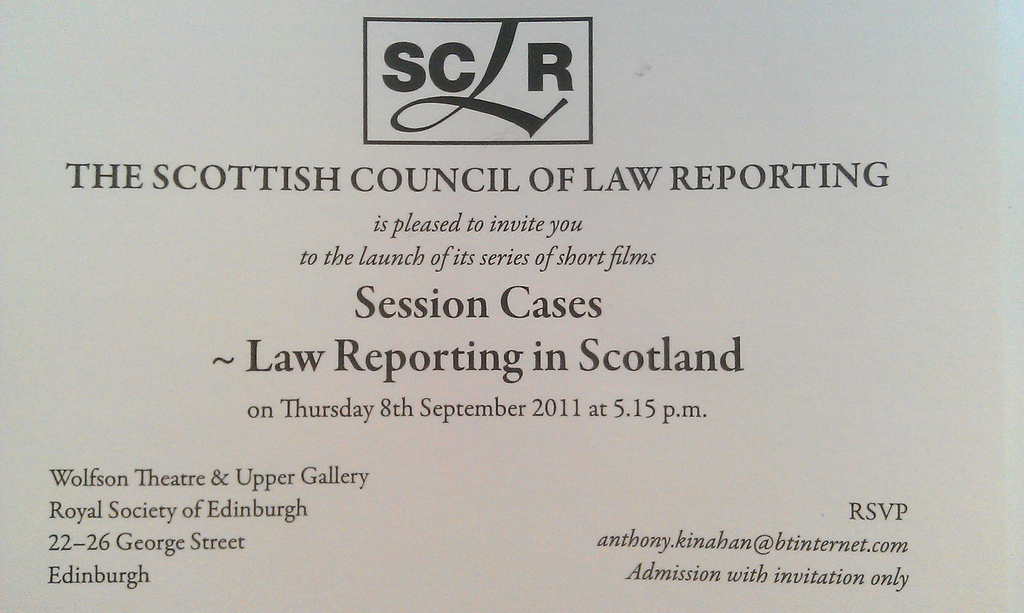
Last night, through nefarious means*, I was invited to the launch of a series of short films on the Session Cases, by the Scottish Council of Law Reporting. The Session Cases are the most authoritative series of law reports in Scotland, and they are created and published by SCLR.

The videos are 5-6 minute segments, available on a dedicated YouTube channel, which outline the history and effects of the Session Cases on Scots law, how the Session Cases developed, how they are put together and by who, and how they are used in court. The video clips themselves are well produced, high quality films, with interviews and commentary from everyone who uses the Session Cases, from the judges and Advocates who write, review, edit and use them in court, to the Advocates Library staff who maintain the collections of Session Cases for the Advocates, and the Session Papers that support them.

Definitely a useful resource for law students, law tutors, those who have to source Session Cases for users, and anyone interested in how Scots Law works.

And, of course, the Paisley Snail makes a regular appearance throughout, in all its ginger beery glory.

One thing I’d disagree with though – the videos said how wonderful it was that most Session Cases were now available as pdfs of the original pages. This is good because it means that the judge and counsel are looking at literally the same page. I’m sorry, but I don’t see this as a good thing: why is a pdf of a page better than an electronic version? They’re often difficult to read, and when passed between parties as an attachment to an email, they aren’t searchable in the same way as an electronic version is. Insisting on pdf versions is a backwards step, and it probably wasn’t disputed because the judges who were interviewed in the videos are the group who prefer the pdf versions.

*It appears that I was invited because I’m technically in charge of my professional group. The inviting system was somewhat odd – the audience consisted mainly of the people starring in the videos, and the people who had made the videos. No actual end users seem to have been invited (I was one of 4 law librarians in the audience, and we all seem to have been invited because we’re allegedly Proper Professionals (me) or were in the video, or were linked to SCLR), and I’m unsure how SCLR are planning on publicising this to their target market, which I assume is law students/law schools.