Thing 12 – social media and networks

Ok, Thing 12 is looking at “the role of social media in building up networks and a sense of community.” Now, I’ve got to say, I do love me a good social network. I’ve been a user of MySpace (back when it was actually cool), then moved on to Bebo, and finally, in the last two or three years, I’ve settled in to Facebook, and Twitter (with the obligatory LinkedIn presence, but I don’t count that as part of my part of my active social network), with a steady background of blogs.

The main benefit that I’ve gained from social media is using it to help me get to know so many professionals outside my own sphere. Scots law librarians are a small group, and our concerns are specific to the materials and data we have to work with. They can overlap when we work with UK issues, but otherwise, we’re focussed on what we need to do to deal with our own needs. Making contact with non-Scots law professionals, and regularly interacting with them has led to me making some great friendships with people who I’d never otherwise have met (and in some cases, I’ve still to actually get to meet in person). When I’ve sent out a cry for help for information on some specialist resource, or unusual materials, these contacts have been able to help me out. Without the funding to go to legal information professional events, I couldn’t have made those contacts in my sector. And I don’t see how, at any other point, I’d have been able to get to know academic or school librarians – our worlds just don’t overlap at all in any other way. It’s led to me regularly working virtually with Bethan Ruddock on our co-mentoring wiki, and I’ve only managed to meet her in real life once so far!

I’ve also benefited from online legal professional friends posting links to materials useful for my work – I often click on legal news links posted by others. They act as a sort of filter: picking up information, assessing it, and passing on the good stuff. In this way, I’ve found new news sources for my work, and kept myself abreast of the hot topics in various legal sectors – which is helpful, as I never know what I’m going to be asked to investigate next, and having a good general awareness of legal issues puts me one step ahead when I’m asked to research things.

I do try and be careful with my use of social media though – I have certain rules for certain sites. For example, on Facebook, I only allow ex-staff to add me – it’s my personal space, and that doesn’t overlap with work. I don’t share any real identifying data (birthplace, birth date, Uni, workplace, location etc) or any particularly personal things in status updates or comments – it’s for light entertainment only. On Twitter, I don’t allow workmates to follow me (nor do I follow them), I don’t use my real name or the name of the place I work, and if I share any information about what I’m doing (such as an interesting/unusual/frustrating research enquiry) I don’t name the person asking, or usually, even their gender. To the outside world, I may well appear to work in an odd place that’s staffed entirely by hermaphrodites. This may or may not be an accurate assumption.

I also don’t like any particular company to have too much access to my personal data – this is why I won’t open a Google+ account (as it would force me to use my real name) and why I immediately deleted Google Wave/Buzz/WhateverItWas when it launched, as it made me use my real name too. I can’t forget that Google’s an advertising company, and whatever it’s giving me for free (an email account, a blog, access to its new toy), I pay for by forfeiting some of my data privacy.

But in general… yeah, social media: I loves it, I does!

Thingee eleventyone – mentals, and mentaling

It’s time to talk about mentals (or mentors, if we’re being awffy formal).

I’ve been mentored a-plenty, both formally and informally, and now I’m even starting to do a little bit of the mentoring stuff myself. So how has it all worked out for me?

The unofficial mentors
In my previous workplace, I worked as part of a team of five staff in an institutional members-only law library, and effectively had a substantial period of apprenticeship to my boss, who spent at least a year supervising the VERY steep learning curve I had to go on. It was mainly her who ended up being the person showing me where things were kept; explaining how those things related to each other; how she’d figured out where an answer might be found for an enquiry we’d received; introducing me to other legal information professionals; and answering the many random and stupid questions I came up with. She also encouraged me to be active in both CILIP, and the group representing Scottish legal information professionals, the Scottish Law Librarians Group. I learned a helluva lot in my years there, mainly through the patient guidance of my boss, and I feel lucky that I had the chance to work in a a great team, with someone who was determined that I should develop professionally, even if that progress meant eventually leaving their team to find new opportunities.

Then, there’s my current boss, who’s had to take me from working in an institutional law library, to working in a commercial law library. The demands of a commercial law firm are very different to an institutional library, and so there I was on the steep learning curve…again. And once again, I’ve benefited from having a manager who doesn’t regard any of my questions as daft (even when they are), never points out the fact that sometimes I can be mind-numbingly stupid, and gives me the leeway to investigate areas and developments that interest me. This mentoring relationship has been different from my previous one, as my current role involves me working in a different office to my boss, so almost all of our contact is through numerous emails and phone calls. Although stressful at first (this went along the lines of having to suppress the urge to yell “Arghghhgh – stop asking me questions like I’m an expert, on areas I don’t know anything about!” when people asked me research questions on topics I’d never even heard of in the five years I’d spent in my previous workplace,) this has actually been beneficial to me, as I can refer back to the emails we have exchanged if I need to, and I’ve had to develop the skill of outlining issues clearly in writing when trying to discuss any complex research I’m asking her for help on, which has helped when I then have to write a clear and readable response to enquiries from users. And although I’m perfectly capable of doing the research my users ask me to do, knowing that I can phone my boss and just talk things through is a great help – I tend to be able to understand things better once I’ve chatted to someone about them, it seems to sort things out in my head a bit better! She’s totally committed to involvement and improvement in the wider library profession (to the point of taking on an insane workload for herself, on top of her full time job), and she’s also unfailingly determined to support me in any professional activity I decide to undertake, and uses our internal appraisal system to integrate activities such as Chartership and Revalidation into my core work objectives. So, all in all, she’s pretty handy as a mentor, official or not!

In addition to my workplace mentors, I’ve recently gained myself a non-employer-related mentor, in the delightful form of Bethan Ruddock, and our work together on a co-mentoring wiki, set up in order to prepare ourselves for Revalidation (public version here). Beth is helping me to track my professional development activities as I go along, rather than the prevous approach of: me doing stuff; me forgetting what I did it; me not reflecting on what I did or didn’t gain from it at the time; and me scrabbling about to try and remember what I did, and why.
In return, I’m doing the same for Beth. Despite only having met once for a few hours in a pub (you may begin to see a theme developing here in regards to my professional development activity venues…), we get on well, and are able to gently guide each other in the right direction in regards to creating the evidence to prove that we’re proper, Revalidatory professionals 🙂

The official one
When I decided to begin my Chartership, I begged/bullied/demanded/did sad puppy eyes in order to persuade lmrlib, a fellow law librarian, to do the Mentor training course in order to be my mentor. I felt I needed someone within the same professional sector in order for them to better understand how a Chartership fitted into my role, and already knowing each other meant that I felt we’d be able to work together well. We took a slightly-less-formal-than-may-be-usual approach to our meetings (A.K.A. we met in various pubs after work…well, a girl’s gotta eat, right?), but it seemed to work out pretty well for us. We’d work together to set targets for things to be done by me, and dates for them to be done by, go over the materials I’d collated up to that point, and discuss what gaps needed to be filled. As she was a friend, I didn’t want to let her down (or discover how truly awful and lazy I really am), so I’d make an extra effort to ensure I was up to date and sorted for our meetings. It also meant I could take any potential criticism a bit less personally, as we could joke about things rather than me thinking a total stranger had judged me, and found me to be a bit rubbish.
That was a pretty successful approach for me!

What did they get from the relationship? And what did I get?
Well, hopefully my bosses have had the benefit of an employee who’s been enthusiastic, keen to learn, and perhaps been able to give something useful back to them, in terms of developing new tools or processes in the workplace.
My “official” mentor has had the chance to see if she really wants to be a powerful megalomaniac, imposing her evil will on powerless underlings (judging from how she managed our relationship, that’d be a definite no).
My un-official un-work mentor has had the dubious benefit of me mentoring her, as she mentors me…

For me, I’ve gained skills, benefited from others experience and knowledge, and have learned various ways of working in order to find one that suits me…yup – having a mentor’s great!

Win a book in a bottle

I like to do crafts in my spare time, and in particular, I like to make mini things. And being a librarian, miniature books are a particular favourite. I cut strips of white paper to size, draw tiny dots and dashes and lines on the paper to represent text sections (it’s too small to write actual words), glue these together onto a paper strip spine, write a short title on a front page (I can fit approximately three or four short words onto the front cover), glue the front and back covers on, sand or trim the pages to equal sizes, then finally decorate the spine and front cover corners.

So, what I’m offering to do today is to give away this mini book, called “The History of Apples”, which fits within the glass bottle you see it in at the top of this post. The bottle lid has a hole, which means this could be worn as a necklace, added to a keyring…or just kept on a shelf to confuse people.

All you have to do is leave a comment below within the next week, completing the following sentence:

“I want The History of Apples” because…”

The most amusing or ridiculous reply is the one who’ll get it!

And…the rest

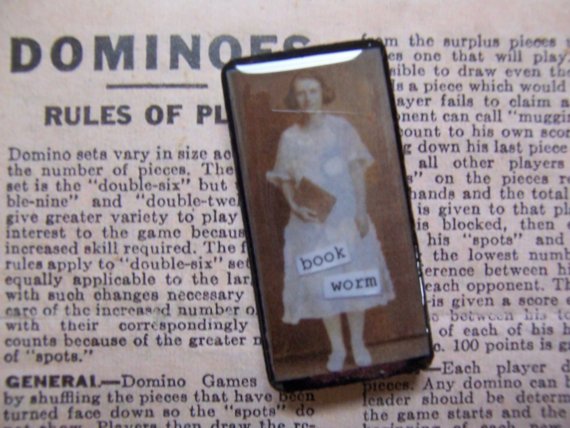
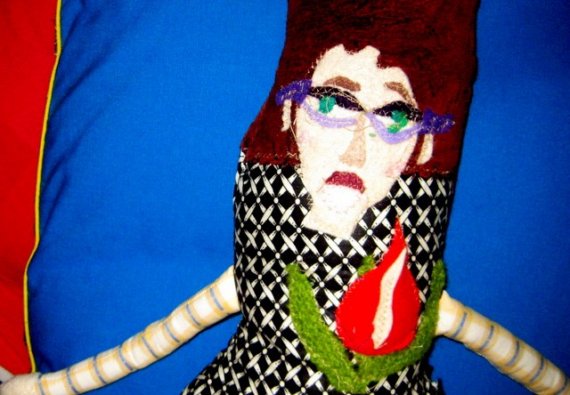
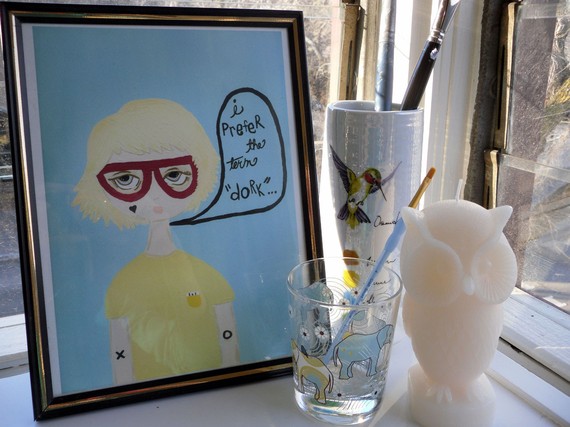
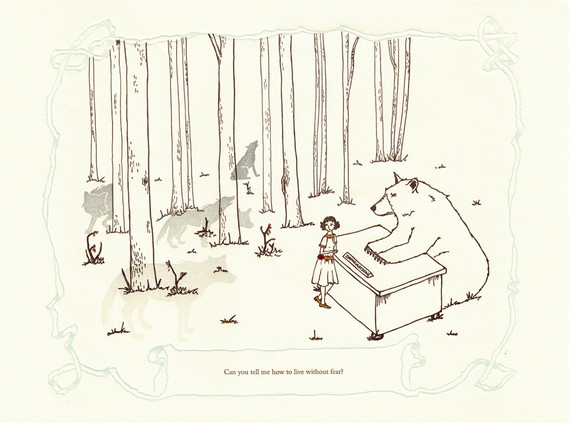
Following the Good and the Bad, this is the WTF category. The contents are…interesting.
Some are fun and cool.
Some are twee-as-Hell, and play on the dowdy/boring/cat-loving old woman librarian theme.
Some have gone for the shushing harridan stereotype.
Some are unusual and interesting.

And some, quite frankly, are terrifying.

I leave it up to you to decide which is which. And whether some of them would find a better home on Regretsy.

Shop
Shop
Shop
Shop
Shop
Shop
Shop
Shop
Shop
Shop
Shop
Shop
Shop
Shop
Shop
Shop
Shop
Shop
Shop
Shop
Shop
Shop
Shop