I think I’m offended

So, after you hit retiral age, if there’s nothing else for you to do at a law firm, you get to become a librarian?

And what does an 88 year old DO in terms of library work? Is it just an honourary title, which allows him to potter around the office, or is he regularly asked to do research?
Did he use online resources, or work mainly with the printed texts?

Actually, I’m genuinely interested – I would love to think he was whizzing about in Westlaw, digging up stuff from LexisNexis Butterworths Direct, looking up the Statute Law Database, shattering preconceptions about older people and technology!!

Although sadly, I think it’s more likely that ‘librarian’ was just a job title they gave him to keep him happy, rather than because he was a great researcher, and helped keep his service users on top of the rapid changes in their profession…

Scottish Law Librarians Group Book Festival event

From BBC News website: “Members of staff at the National Library of Scotland point to an extract taken from one of the first books printed in Scotland, which forms part of the 500 years of the Scottish Printed Word exhibition. Photo by Jeff J Mitchell/Getty Images.”

If you’re a member of the Scottish Law Librarians Group (SLLG), you’ll have already been sent your invite to this years event at the Edinburgh International Book Festival.
The SLLG likes to try and ensure that members get the maximum benefit from the group, and as last years Book Festival visit proved so popular, it’s been decided that this should become an annual jaunt.

So, this year, we’ve selected the following as (hopefully) being of interest to as many members as possible, and at a good time to allow everyone the chance to attend:

“Bill Bell, David Finkelstein & Alistair McCleery: Books and Society
Tue 19/08/2008
12:00 PM – 1:00 PM
As Scotland celebrates 500 years of printing, editors David Finkelstein, Bill Bell and Alistair McCleery reveal the remarkable contribution to publishing and literary culture made by Scotland over the last 120 years – a period covering momentous change in writing, publishing technology, bookselling, readership and, of course, book festivals.”

Tickets for this event for SLLG members will be paid for by the group, so it’s free, free, free!
The image above (I think) relates to this event too, as this talk supports the exhibition referred to.

You can download the Festival Brochure from the website.

SWOP meeting: "From Parliament Square to Holyrood โ€“ historical official publications online"

Belatedly writing up the SWOP meeting, which I posted info about here. Links to available presentations here.

This turned out to be a really useful and interesting event, even though it may have been aimed more at academics and researchers than anything else (it was only me and someone from a Council who weren’t academic staff).

  • “Parliamentโ€™s past online : a review of sources” Paul Seaward Director โ€“ History of Parliament Trust.

This part was full of interesting historical information, and background on UK Parliamentary materials development e.g House of Lords and House of Commons records were stored in different buildings, so a fire in 1834 that destroyed HofC records prior to that date had no effect on HofL records. Parliament Rolls and Statute Rolls are separate. Parliament Rolls of Medieval England (subscription service) and BOPCRIS (an HE and FE academics access only site). So, there’s sources, but you have to be an academic to view them, from the looks of it!

  • “From archive to internet: producing an online edition of the records of the pre 1707 Scottish Parliament” Gillian MacIntosh St Andrews University

A review of the background to the development of the Records of the Parliament of Scotland online. Highlighting the lovely option for parallel translations from old Scots, that can be viewed alongside their modern English translations. Noting that there’s now a citeable reference style for the old Acts (eg [1604/4/22], denoting year, month and number of the Acts), and original sources are given, unlike the previous printed edition, which is now known to be inaccurate and suffered from the editors personal bias!

  • “Prototyping Hansard” Robert Brook, UK Parliament

An un-official, ad-hoc project, working with the raw Hansard data and reusing it in various ways. It’s a very basic, non-prettified version of a website, but it allows users to search on tagged items to find all sorts of information on them, eg, by member name like Tam Dalyell. They specifically don’t work with the most current data, stopping at 2004.

I have to confess to tuning out slightly for the following presentations:

  • “Online Historical Population reports” Matthew Woollard โ€“ Project Director, Online Historical Reports Project.
  • “Digitisation of Parliamentary Texts at BOPCRIS” Dr Julian Ball, Project Manager, BOPCRIS
  • “ProQuest Parliamentary Papers” Rob Newman, Senior Editor, Proquest CSA

These were very definitely aimed at the academic sector, and researchers of population / history, and therefore not of particular use to me.

But overall, definitely an afternoon well spent – I have a far better understanding of where the historical parliamentary materials came from, why there’s gaps, why the printed collected Scottish Acts are unreliable, and now know about a funky online tool to play with Hansard! ๐Ÿ˜€

Better late than never…


Well, on Saturday I got home in the evening (after a corporate fun day out which was, actually, really good fun) to find a “We tried to deliver but you were out having a life” card from the Royal Mail. I’m well used to these by now, as mail delivery time seems to be between 11am and 3pm in my area. Apparently, working and receiving mail are mutually exclusive activities in this fine city.

So yesterday, I did my regular detour to the Depot to collect my undelivered mail. What I ended up collecting was a huge beast of a hard backed envelope, slightly oddly addressed: the teeny-tiny fact that I live in Edinburgh, capital of the country has been omitted from my address. Apparently I now live at the following location:

Jennie XXXXXX
XXXXXXXX
Lothian
XXX XXX

Lothian? I have a region but not a city now?
Then I saw the sticker on the envelope saying it had come from CILIP, and all was made clear. They’ve made yet another boo-boo. Not as good as the beginning of this year, when they spontaneously relocated my home address to the building next door to the flat I used to live in 2 years and 2 home moves ago, but still, pretty good work…
Perhaps they’re working up to only putting nations on address labels eventually, by beginning with dispensing with all this petty bureaucracy about actual streets and cities?

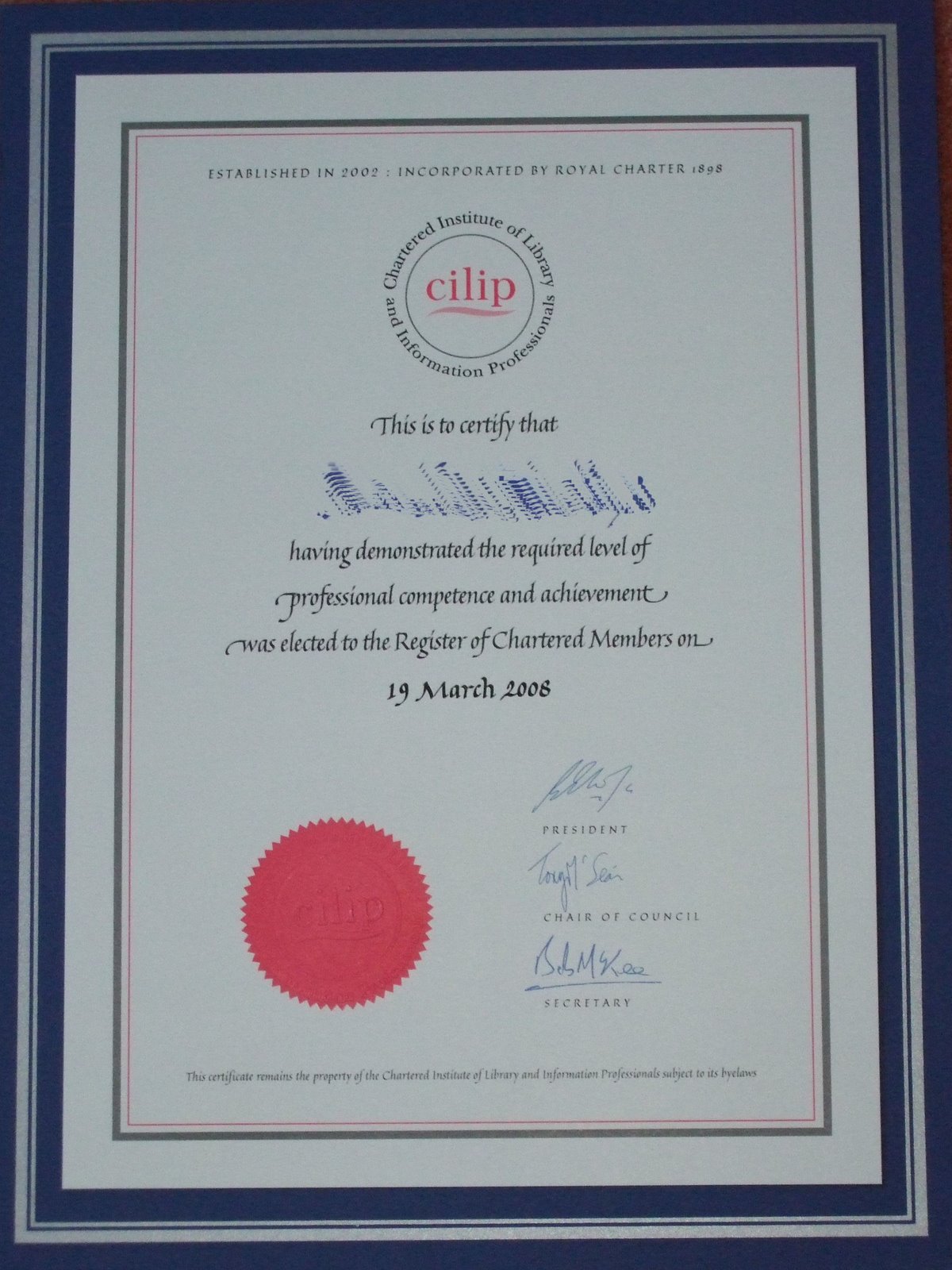
I knew then what it must be: my Chartership certificate. 9 months after submitting my portfolio, 3 months after the official acceptance of my portfolio in March, I have a snazzy certificate, all prettily mounted (can’t fault them for their presentation!), and ready to, erm..be sent back to my parents for safekeeping, along with the degree and postgrad diploma certificate.

So here it is, in all it’s glory.
Woo.